
“NAZA” is one of the most controversial films of the year. So when I learned that it was included in Dokyumentado’s lineup this year, I immediately filed for leave from my regular job, two days before the screening, determined to see it.
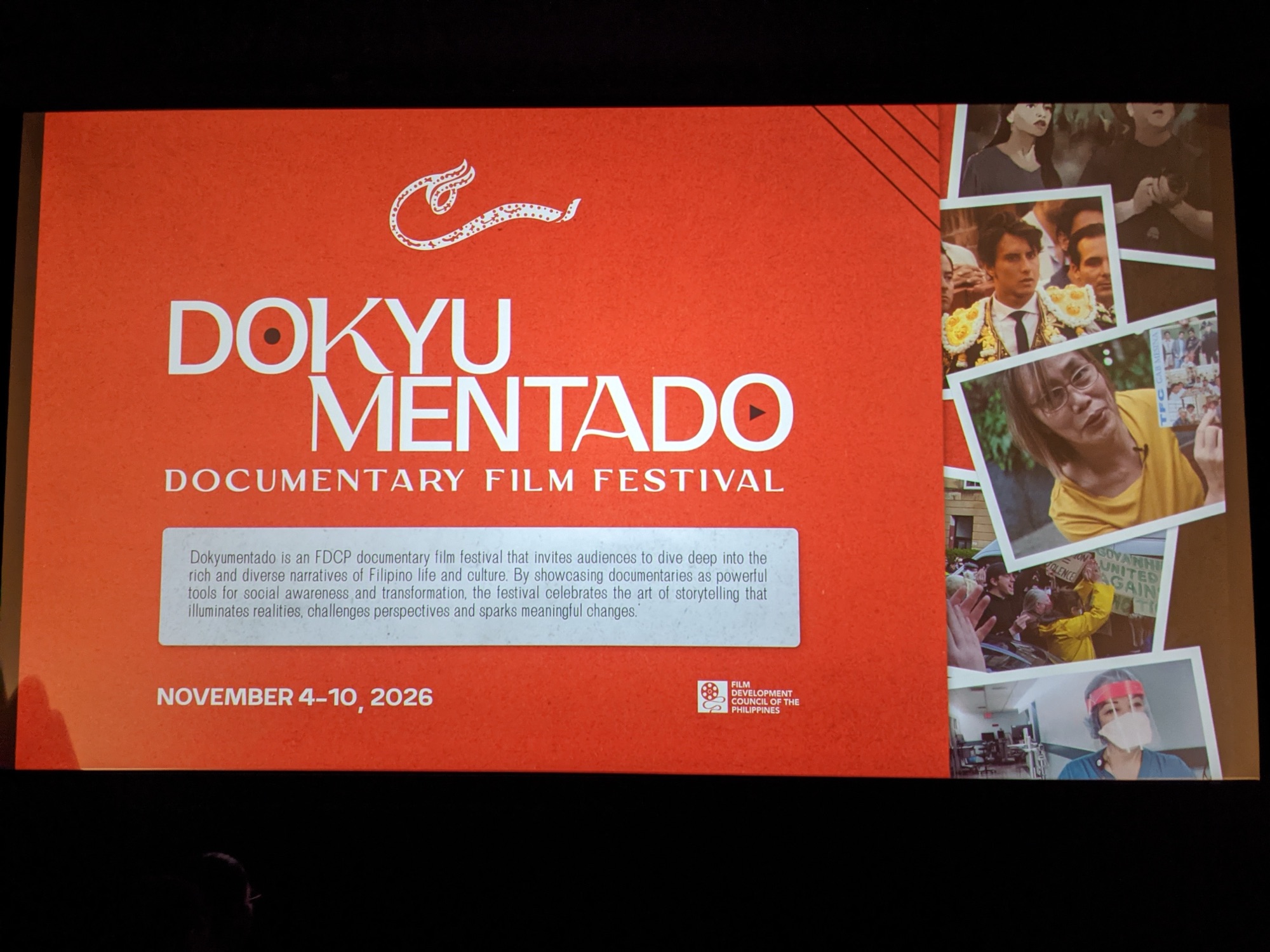
Dokyumentado is a documentary film festival that celebrates documentary filmmaking as a means of raising social awareness, challenging perspectives, and telling stories that inspire change.
I arrived at Cinematheque Centre Manila an hour before the second screening, expecting that I would have enough time to secure a seat. But the queue was already growing, and despite obtaining a queue number, I eventually learned that the cinema had reached full capacity. The overwhelming turnout spoke volumes. Meanwhile, I recognized several familiar faces from the Philippine media and film community in the lobby, including Nick Deocampo, Baby Ruth Villarama, Mae Paner, Inday Varona, Patricia Evangelista, Raffy Tima, and Atom Araullo.
Relief came when Direk Jose Javier “Joey” Reyes, chairman and CEO of the Film Development Council of the Philippines (FDCP), announced an additional screening at 7:30 PM for those who had secured queue numbers but failed to get into the second screening.
And so, I got another chance to watch what would turn out to be one of the most devastating documentaries I have ever seen.
Directed by Israeli journalists Yuval Abraham and Rachel Szor, “NAZA” is co-produced by The Guardian and JW Films. Abraham and Szor, who also co-directed the Oscar-winning “No Other Land,” turn their attention to the inner workings of Israel’s military campaign in Gaza.
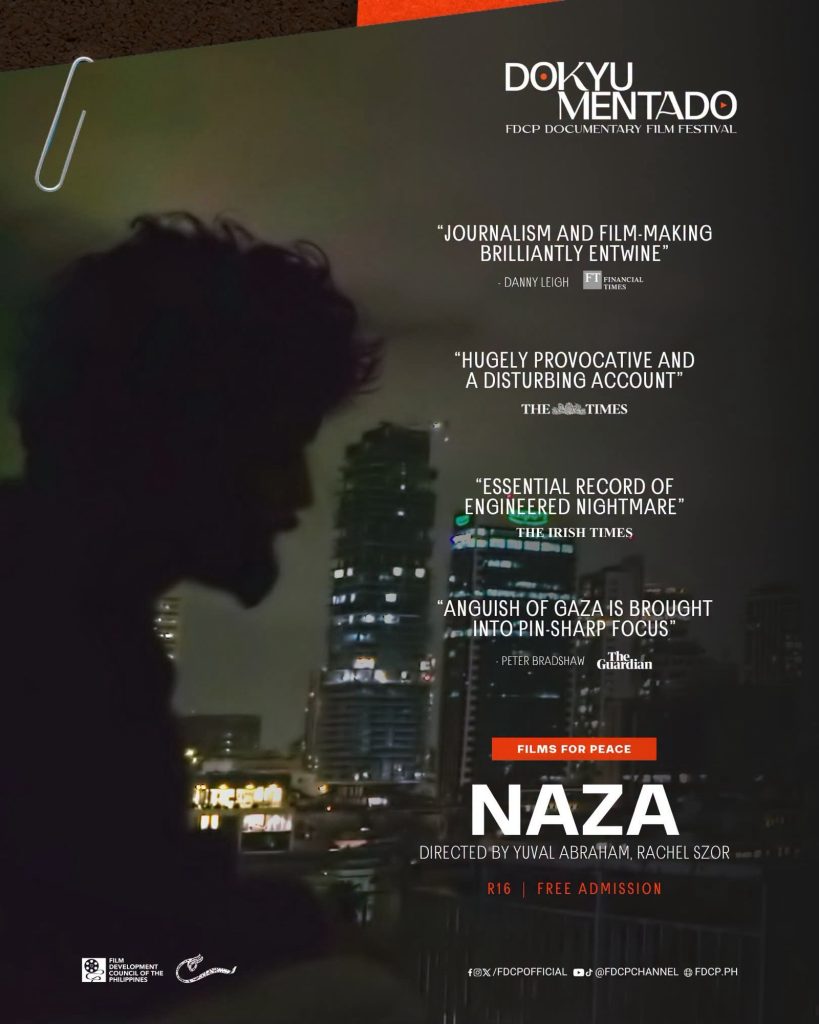
The title “NAZA” refers to a Hebrew military acronym associated with anticipated civilian casualties or collateral damage. And that is precisely what makes the documentary so chilling: civilian deaths are not merely consequences assessed after an attack. According to the testimonies presented, they can be anticipated and incorporated into military targeting calculations.
As one of the interviewees recounts, “They do not say ‘civilians.’ They don’t call them ‘victims,’ or ‘people,’ or ‘innocents.'”
The film features 24 anonymous Israeli military intelligence officers and soldiers who reveal details of the surveillance systems, intelligence gathering, and targeting procedures used in Gaza following the October 7, 2023, Hamas-led attacks. Their faces and voices are disguised, with interviews conducted at night against the backdrop of Tel Aviv. Their accounts expose a disturbing system involving mass surveillance, cellphone tracking, AI-assisted targeting, and the use of algorithms to identify potential targets.
One particularly disturbing system discussed in the film is called “Where’s Daddy?”, which reportedly monitors communications involving family members to identify when suspected militants return home, potentially placing their families in the path of an airstrike.
Interestingly, the film prioritizes the testimonies of Israeli military insiders rather than Palestinian victims. Abraham and Szor effectively allow those who participated in the system to explain how it operates. This makes it difficult for Israeli society to dismiss the allegations as foreign propaganda when the revelations come from within its own military establishment. This approach is powerful, although it is not without limitations. Critics have pointed out that the film gives Palestinians little opportunity to speak for themselves. Instead, their agony is largely conveyed through the accounts of Israeli insiders, with Palestinian footage appearing most prominently toward the end.
Nonetheless, the result is devastating. We see the bureaucratic and technological machinery behind the genocide in Gaza, while life in Tel Aviv carries on uninterrupted.
The documentary also raises uncomfortable questions about Israeli Prime Minister Benjamin Netanyahu. Archival footage shows him defining terrorism in terms of the deliberate targeting of civilians for political objectives. The irony is difficult to miss. A leader who has repeatedly invoked the language of counterterrorism to justify military operations is confronted by testimonies describing the anticipated deaths of civilians in those very operations.
Netanyahu’s response to the documentary is equally troubling. In October 2026, he ordered Israeli authorities to identify the military personnel interviewed in the film and pursue criminal investigations against them, while also attacking the filmmakers and their work. Instead of publicly addressing the allegations, the government’s response raises serious questions about its treatment of whistleblowers and journalists seeking to expose possible abuses.
And the risks are real. The anonymity of the interviewees and the filmmakers’ exposure to political attacks underscore the dangers of investigative journalism when it challenges powerful military institutions.
Watching “NAZA” also made me think about our own government’s relationship with Israel, which has long been a crucial supplier of military equipment to the Philippine armed forces. Under the Marcos administration, defense procurement arrangements have continued, including a documented Philippine Army contract worth approximately P248 million for precision-guided ammunition from Israeli defense company Elbit Systems.
Indeed, the Philippines’ continuing military relationship with Israel deserves scrutiny, especially given the significant military support that the superpower United States provides to Israel. The pursuit of military modernization should not prevent us from asking difficult questions about the countries supplying our weapons and the human rights implications of those partnerships.
Another scene that stayed with me involved the Holocaust Remembrance Day. A siren sounds, and commuters and motorists in Tel Aviv stop for a few minutes to commemorate the millions of Jews who died in the Holocaust.

Remembering the Holocaust is important. Its atrocities must never be denied or forgotten. But watching this scene alongside the destruction of Gaza was nerve-racking. How can a state whose national memory is deeply shaped by the horrors of the Holocaust pursue a military campaign that has brought such devastation to another people?
I missed the earlier talkback session with director Monster Jimenez and photographer Martin San Diego. But I found the third screening to be a more solemn experience. Without the introductions and other pre-screening formalities, the audience was left to confront the film on its own terms.
When the screening ended, there room fell into an almost complete silence. No immediate applause, no whispering. People seemed to need a moment to absorb what they had witnessed. Perhaps there were simply not enough words to describe the harrowing destruction of Gaza.
The final images, particularly that of a Palestinian father searching through the rubble, were difficult to shake off. Behind the military terminology and technological calculations are actual human beings: mothers, fathers, children, and entire families whose lives have been destroyed.
“NAZA” is not an easy film to watch, but it is an essential one. It forces us to look beyond the headlines and confront the machinery and institutions behind the continuing atrocities in Gaza.
Because when civilian deaths become statistics, when destruction becomes policy, and when those who expose the truth are threatened, silence is no longer neutrality. It becomes complicity.
(FDCP’s Dokyumentado runs until November 10 at Cinematheque Centre Manila)

Daniel is an avid lover of music and films. While most people his age would spend their leisure time playing online games, he enjoys creating playlists and movie lists. Daniel has also written opinion pieces for various publications. He studied Political Science at Adamson University and is currently an associate at the Depository Trust & Clearing Corporation. He would never say no to a cold beer!