
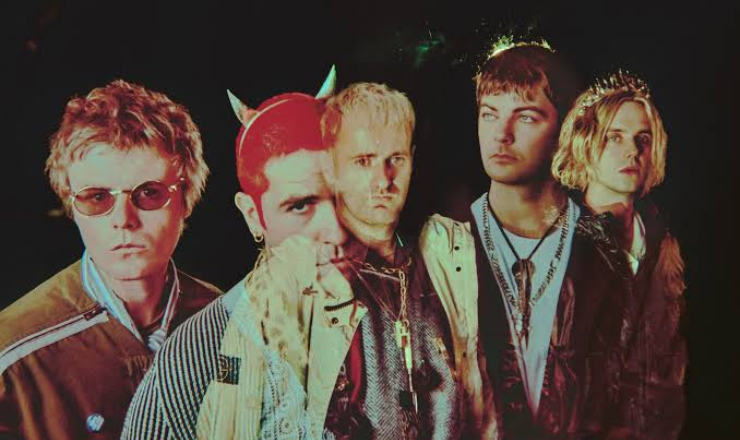
I begin this Dopamine Chamber album review with a folly introduction to Fontaines D.C., as my initial entry point to the five-piece Dublin band was less about their place in the post-punk canon and more about an oscillating fixation with Cillian Murphy, combined with my newly sparked interest and engagement with the overall state of the 2020s rock scene.
Having only properly directed my attention toward them this year, I am still gradually figuring out the band’s frontman and primary songwriter Grian Chatten. He remains an enigmatic figure — a lyrical puzzle I am determined to solve.
In attempting to write about Fontaines D.C. and Chatten, I find myself confronting a shadow: my own skepticism. Recognizing their musical DNA is effortless; it’s easy to hear echoes of Joy Division’s dark precision, The Cure’s gloomy atmospheric sheen, and even the unapologetic, melodic swagger of Oasis or Stereophonics (regardless of whether the band or their die-hard purists might resist those comparisons). Because these influences sit so plainly on their sleeves, I refused to put the band on a pedestal. If anything, my instinct was to do the opposite.
Yet, despite this cynical instinct, I am thoroughly captivated and utterly consumed by them. It’s never a bad thing, and in this era of nostalgia, Fontaines D.C. has capitalized on listeners’ desires to discover a new band that embodies the best elements of their favorite groups. Listening to the band, I can hear a convenient synthesis of several European artists I’ve admired over the years, from The Cure, The Smiths, Blur, Oasis, Joy Division, Kasabian, Radiohead, Pulp, and The Stone Roses, to the 80s pop synth presence of Depeche Mode, The Psychedelic Furs, New Order, and A-ha.
I thank the band for making me realize that after all these years, Euro rock has been my favorite staple, and has silently formed my own band’s sonic sensibilities. I know it’s quite hypocritical at its core, like how I abhor all things imperial, while I cannot resist devouring them. But hearing the hypnotic voice of Chatten brings me further to study his poetry, and what he means as an artist. Hence, challenging myself to write this album review requires dissecting every lyric of this 11-track record.
The first track, Six Shot Morning, is an immediate sign that the album is a force to be reckoned with. The initial orchestral soundscapes made me feel things that rarely happen to me anymore, perhaps not since the meteoric rise of indie sleaze in the late 2000s to 2010s. What I always refer to as a musical orgasm has definitely kept me single for most of my life: not craving human flesh, but always looking for the next dopamine hit in music. And the verdict for Fontaines D.C.? The rest of Dopamine Chamber satisfied me, or no, scratch that. It made me feel alive.
Dopamine Chamber is a kaleidoscopic and philosophical account of what agitates modern society: instant gratification, escapism, detachment, envy, identity, burnout, self-sabotage, isolation, and any other internal conflicts, to which every person can relate.
What I take of most of Grian Chatten’s poetry is that it is relatable, personal, social, and a bit political at the same time. But what stands out to me is his maturity and sense of accountability. I can clearly see that this artist is so self-aware. At least in his latest album, he takes accountability, doesn’t blame or gripe, and his sarcasm directs towards mostly inward and to society at large, not towards a person he could easily indict.
Six Shot Morning alludes to how the modern world has succumbed to instant gratification, hedonism, and a lack of sacrifice and discipline. Where Is Gone featuring Rosalía, talks about grief over lost intimacy. Tongue grapples with holding back the truth when it is necessary. Demolition is about emotional unavailability, the fear of vulnerability, which definitely define what modern dating struggles with the most.
In Marianne, Chatten sings, “Cinematic feeling / Understand this is your life / You can go on dreaming / You can go under the knife.” The song illustrates the problems with escapism, and body and image identity. Mimesis talks about imitation, performative actions, and loss of originality.
One Man is about imperfections and takes accountability for the things done wrong, while still trying to make up for it. Then the three other love songs, Japan, You Miss Me, and Intimate talk about romanticization, escapism, nostalgic delusion, and isolation. Happy For You, the track I find myself on loop, apart from Demolition, wrestles with a bit of bitterness, desperation, and the rife of not being able to let go and trying to control things, while trying to “preserve” a lover’s sovereignty.
Dopamine Chamber functions as a direct reflection of a culture spiraling in real time. We live in an era hyper-fixated on micro-trends, endless digital noise, and performative intimacy, where genuine human connection is traded for low-effort and high-speed validation. Modern society has become obsessed with quick fixes, choosing to reject uncomfortable truths rather than face them. What Fontaines D.C. achieves here is taking that collective anxiety, burnout, and superficial frenzy and shaping it into a stark, unvarnished portrait. Every track describes our modern dysfunctions and it reflects back the quiet desperation of a society perpetually chasing its next hit just to feel something real.
Fontaines D.C. executed the album with an urgency that feels entirely necessary for right now. They haven’t just delivered another nostalgia trip but have created a record that hits hard enough to remind us what it feels like to be alive, raw, and accountable in a world that constantly encourages us to numb out.

NeP-C Ledesma is a millennial writer and entrepreneur full of curiosity about our abstract world. She devours Psychology, food, Philosophy, and prefer cats as her all-time company. Pop Culture is her kryptonite.