
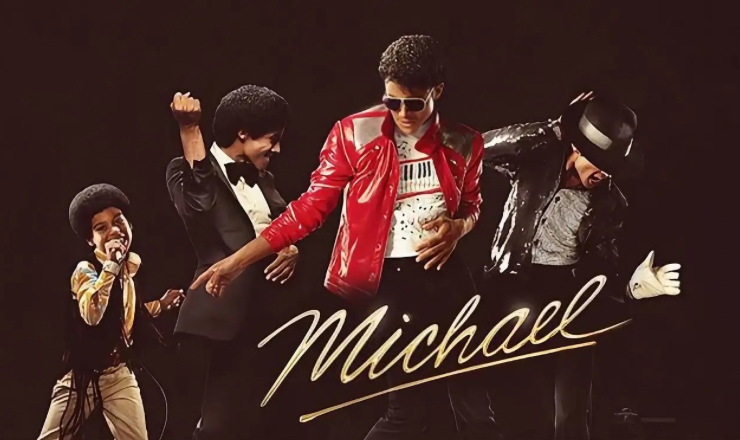
A raw and cerebral interrogation of the Michael biopic that bridges personal grief and 90s nostalgia with a sharp critique of the global media machinery and the complicated legacy of a man who both defied and manipulated the system.
About a week or two before “Michael” was released in theaters, several advance screenings were organized for selected journalists and content creators. I wasn’t invited to attend, but I noticed that most of the initial reviews for “Michael” were negative, resulting in a score of only 38% on Rotten Tomatoes.
But it didn’t stop the biopic to hit box office, making at least $300 Million worldwide as of this writing.
Some of the worst reviews I read claimed the movie was propaganda, created solely to enhance Michael Jackson’s image. Others suggested that the Jackson estate’s motivations were primarily financial or aimed at advancing Jaafar Jackson’s career. But the thing is, the movie is just getting started. They can’t fit Michael’s story into the film, and a sequel is on the way.
While many of these criticisms may not be unfounded, fans were already convinced that despite the reviews, their curiosity was off the charts, and curiosity is an understatement. They simply wanted to experience Michael Jackson once again.
Growing up in the 90s, Michael Jackson was a huge part of my pop culture-laden childhood. He was everywhere, and I had the opportunity to experience his latest music firsthand, rather than just as a nostalgia piece. I was already a semi-conscious kid at the time when he released “Will You Be There,” one of my favorite songs as a three-year-old kid, especially since it’s part of the movie “Free Willy” (yes, my parents told me that as young as one or two, I could already recognize the melodies of pop tunes). Of course, accountable for this is my father who was a big MJ fan.
I watched the movie knowing all the public information there is about Michael Jackson. As a true-blue music fan, it was already instinctive or reflexive for me to watch the King of Pop’s biopic.
I looked forward to the cast, especially Jaafar, MJ’s nephew, who portrayed him. MJ passed away in 2009, the same year one of our former presidents in my country also died. I remember feeling sad about MJ’s death, even though a friend of mine mocked me, thinking I was just following a trend. However, when Cory passed away, I didn’t feel anything at all. Perhaps because I didn’t get to experience her term as president and that I heard a lot of abominable things she did for my country. My point is, while I may not be among the top 100,000 fans of MJ, I would certainly place myself in the top one million.
So I ask you to take this write-up as something more personal, because when I watched “Michael,” there were “feelings.”
The initial feeling I experienced was sorrow, as I watched it without my father and regretted that he wasn’t there to share in the experience. I had a similar emotion when I watched “Top Gun: Maverick,” particularly when Val Kilmer appeared on screen. I had seen the Freddie Mercury biopic with my father, which was produced by the same team behind “Michael.”
Now, I experienced strong emotions in the movie on at least two occasions. The first was when, as a child, MJ longed to play with other children. The second was when his father physically punished him for being defiant. I was also moved during the scenes where he read “Peter Pan” repeatedly.
The movie primarily showcased the heartwarming moments of Michael Jackson, like his visits to sick children in the hospital, his love and devotion for animals, and, of course, the creation of his biggest hits, including “Thriller,” which was my number one favorite music video as a child. I was also aware of how childlike MJ was, shopping for toys and playing fun games like Twister, especially since he missed out on much of his own childhood. His incredible relationship with his mother Katherine (played by Nia Long) and his bodyguard Bill Bray (KeiLyn Durrel Jones) were perfectly demonstrated.
They also showcased a glimpse of Michael’s creative process, highlighting how he worked with Quincy Jones (Kendrick Sampson). MJ would pause, relax, and wait for inspiration from God. He once said, “If I’m not there to receive these ideas, God might give them to Prince.” I’ve always known that both MJ and Prince were very spiritual, which is one of the reasons I admire them both. While people often compare them, they share a mutual respect and love for each other’s artistry.
One key scene that I didn’t know and that shocked me in “Michael” was when it revealed that MTV had not played music videos by black artists at that time. It was Michael Jackson who convinced Walter Yetnikoff (played by Mike Myers), the President of CBS, to threaten MTV. He stated that he would pull all their artists if they didn’t include “Thriller” in their rotation. This situation publicly exposed MTV’s early racism.
The cast was outstanding. Juliano Krue Valdi gave an impressive performance as young Michael. He was discovered while performing as a Michael Jackson impersonator and auditioned for the role. The kid has great dance moves and is also an excellent singer. He performed “ABC,” and although his voice was mixed with original MJ recordings, he did a great job. Juliano is ambitious, and I look forward to seeing more of him in both the movie and music industries.
Now let’s move on to Jaafar Jackson. I’ve seen almost every interview with him recounting how he first got the role and how he prepared for it.
Jaafar was perfect. Period. His voice, dance, and energy all embodied Michael Jackson. As a moviegoer and entertainment enthusiast, I don’t often find myself astonished by many portrayals in biopics. However, in “Michael,” I was repeatedly awestruck throughout the film. Jaafar truly captured Michael’s essence, almost as if he were possessed by Michael’s spirit.
We all have criticism about nepotism, but it’s important to recognize that Jaafar was truly fit for the role. First, he has the right DNA. He’s got the Jackson moves and soulful tone. You can’t deny it. I listened to Jaafar’s single, “Got Me Singing,” released in 2019, and he sounded like Michael in the first line. I also saw some of his performances pre-”Michael” preparation and he truly sounds like MJ! Perhaps he really looked up to his uncle. While he certainly has his own unique style, the first line of the song made it clear that, if I were the producer for “Michael,” I would have also considered Jaafar for the role.
Additionally, Jaafar shares a close bond with his uncle, having observed him not just as a pop star, but also as an uncle, friend, brother, son, and father. He witnessed the full spectrum of his uncle’s life.
Many people had portrayed Michael Jackson from past movies, series, and musicals, but they lacked the special interaction that Jaafar had with his uncle. This connection makes it easier for him, yet he still did a wonderful job. I recognize all the pressure and hard work he put into this movie, and I salute him for that.
While watching “Michael,” I initially felt that like “Bohemian Rhapsody,” it was overly sanitized. However, I eventually found myself grateful for this sanitization. I realized that I wouldn’t be able to handle a more intense biopic that delves into all the hardships Michael faced while growing up and transitioning into adulthood, where he experienced all the cruelties the world had to offer.
I have a different take on Freddie Mercury. I wanted to see all the debauchery in his life and his wrong choices, as much as I wanted to experience his genius and authenticity as a great human being who, like Michael, loves animals, especially cats.
However, in the second Michael film, it’s critical for the production to be pragmatic and bold, to show all the important events in MJ’s life. It cannot be denied.
I believe that MJ’s difficult childhood may have affected me, especially in the first film. Paris, her daughter, was right. Not everything was shown, and many aspects were altered. For instance, the dynamics of sibling rivalry and jealousy were completely omitted, which is likely what Paris would have wanted to be highlighted. Additionally, John Branca (Miles Teller) was portrayed as a positive figure. He was, at some point, but he also took advantage of Michael. These storylines could be addressed and improved in a sequel to “Michael,” provided the estate is willing to confront the past and acknowledge their flawed but “human” actions.
The Jackson patriarch Joe Jackson’s dictatorship was fully demonstrated, but not as heavily expressed, not because of a lack of acting (I love Colman Domingo’s portrayal) or directing, but perhaps because of a lack of “intention” behind it.
Before we move on to the following sections, I want to offer some explanation. I haven’t gathered enough courage to say what I’m about to express, so I need to justify all my thoughts, beliefs, and the way I process them.
I believe I am a sensible person and that I don’t easily get swayed by conspiracy theories. However, I have been an activist in my own right and am keenly aware of society’s class divide. Many of my writings address issues related to class and propaganda.
You have no idea how many times the media has disillusioned me. It’s not just that the traditional and mainstream media outlets are paid to spread propaganda but because they are owned by the richest and most controlling people in the world.
According to a study by Oxfam in January 2026, more than half of the world’s largest media companies are controlled by billionaires (and these are not just Bezos buying Washington Post, but the secret old rich that have been the owners of mainstream media for the longest time). This ownership concentration allows the ultra-wealthy to translate money into political influence by shaping public debate, setting news agendas, marginalizing dissenting voices, and normalizing policies that favor the rich.
Oxfam warns that the danger isn’t always direct censorship, but subtle influence over which stories are prioritized and whose voices are heard, often through opaque algorithms. The report ties billionaire media control to rising inequality and democratic backsliding, with highly unequal societies facing greater erosion of civil liberties and suppression of critical journalism.
I researched the Oxfam study and many other similar reports to support my critical assessment of the media. Both the global and Philippine media have disillusioned me since 2008. As the years have passed, my disappointment has only deepened. Since that time, I have become cynical about the news, yet I still hold onto hope, waiting for a moment when they prove me otherwise.
I shared that to justify my thoughts in the following paragraphs, which include a Candace Owens video where she demonstrates all the heinous work of the deep state against MJ. While Owens’ take is “conspiratorial,” it aligns with the patterns of power I see in the world today. But read until the end, as I expose that Michael was no saint.
I knew that the Jackson family was involved in the production of “Michael,” along with some of Michael’s not-so-favorite people. Janet and Paris are opposed to the project because of the reasons I just mentioned, as well as their dislike for the way Michael’s legacy is being exploited. On the other hand, Prince (MJ’s son) and Katherine (MJ’s mother) hold a neutral stance on the matter. Personally, I also align with the neutral side.
I understand where Paris and Janet are coming from, and I agree that some people may be motivated by financial gains. However, I believe Michael stands to gain more than lose from this situation. Since watching the movie, I’ve discussed it extensively with my sister, which has filled my feed with content about Michael Jackson, his legacy, and his contributions to humanity—topics I’m well-versed in and will elaborate on shortly. I’ve also reflected on the negative treatment he received from the media and his detractors.
Like many of his fans, I’m glad we’re talking about Michael again. I remember the days leading up to his supposed 2009-2010 concert, “This Is It.” As I delved into various videos and articles about him, I found reasons to believe in his innocence. Despite being part of the elite circle and having acquaintances like Trump and Epstein, it was clear that he wasn’t particularly close to them. In the end, he remained defiant against the system.
The child molestation and sexual abuse accusations have been around since the 90s, but in 2005, he was acquitted of all 14 charges against him. Apart from that, Macaulay Culkin stood by his friend and denied the rumours.
I’m not saying that I fully believe Michael, because we can never be certain. But based on the videos I’ve seen, I saw Michael in full defiance of the powers that be. In many of his speeches, he exposed the exploitation that record companies inflict on their artists, which is a very crucial issue. That has been the system since time immemorial, and to this day, many artists are more than shortchanged. Michael also talked about certain forces controlling the world.
In her video “Michael Jackson: The Truth,” Candace Owens argues that Michael Jackson was the victim of a coordinated smear campaign orchestrated by powerful music industry figures after he began speaking out against exploitative record labels. She claims that the initial 1993 molestation allegations were fabricated by Dr. Evan Chandler, who she asserts drugged and coerced his son into a confession to extort Jackson for money.
Owens further contends that the mainstream media weaponized “Wacko Jacko” narratives and labels of anti-Semitism to dehumanize him, despite his 2005 acquittal and a lack of physical evidence. Ultimately, she characterizes Jackson’s financial decline and death as the result of a “mafia-style” industry retaliation designed to ruin his reputation and estate because he challenged the control of executives like Tommy Mottola.
While all these are favorable to Michael Jackson, he was no saint. He might even be, allegedly, a con-man himself, and Candace Owens failed to inject this in her video (shared above). In 1995, MJ secured his 50% stake in Sony/ATV Music Publishing, which includes The Beatles catalog. It was Paul McCartney who first told MJ about how lucrative it was to own artists catalog, and so MJ went to secure Sony/ATV, but without the intention of giving back his dear friend’s music rights. Yes, that’s where I hated Michael, and think that he’s a hypocrite.
Despite everything, I’m delighted that they produced “Michael.” This is just the beginning of Michael’s story, and it’s no surprise that we felt all the love for him.
However, the challenge arises when they release the sequel, in which according to an interview with Jaafar, is already in development, but they could face problems if Janet Jackson does not permit her portrayal, like in the first film.
While the first movie is all about “feelings” for me, I expect the second film to be bold and gritty, to show the good and the bad of MJ, as well as the people who surrounded him. If not, I can hardly wait to be extra critical about it.TPB
References and Sources:
- Michael (2026). Rotten Tomatoes. https://www.rottentomatoes.com/m/michael
- D’Alessandro, A. (2026, May 1).
‘Michael’ Workin’ Day And Night: Crossing $300M WW To Become No. 2 Musical Biopic Ever – Box Office. Deadline. https://deadline.com/2026/05/box-office-michael-worldwide-1236878600/ - Luciditycomix (2025). As a true fan I have mixed feelings about John Brancas involvement in this film. Reddit. https://www.reddit.com/r/MichaelTheMovie/comments/1j4jht8/as_a_true_fan_i_have_mixed_feelings_about_john/?rdt=43164
- Bernays E. (1940). Propaganda. History is a Weapon. http://www.historyisaweapon.org/defcon1/bernprop.html
- Maitland, A., Taneja, A., Kamande, A., Brown Solá, C., Bignell, H., Lawson, M., & Stahl, R. M. (2026). Resisting the rule of the rich: Protecting freedom from billionaire power. Oxfam International. https://doi.org/10.21201/2025.000113
- Left, S. (2025, June 14). He Beat It. The Guardian. https://www.theguardian.com/news/2005/jun/14/wrap.sarahleft
- Explaining His & Michael Jackson’s DEEP Connection | Macaulay Culkin in his own words (2023). the detail. https://m.youtube.com/watch?si=BYJYSG-fK1FhQYYY&v=D6BIhGnoNTg&feature=youtu.be
- Susman, G. (2002, June 6.) Michael Jackson joins artists’ fight against labels. Entertainment Weekly. https://ew.com/article/2002/06/06/michael-jackson-joins-artists-fight-against-labels/
- Michael Jackson – 60 Minutes Interview. (2019). MJLiveHQ. https://m.youtube.com/watch?si=LneEzYUPkuflQkmE&v=-GF2JUe-2Is&feature=youtu.be
- Owens, C. (2020 April). Michael Jackson: The Truth. Candace Owens. https://youtu.be/6iAYN0vVcQ0?is=AGBArhHtg6q2X9Qo
- Bertram, C. (2020, September 8.)
How Michael Jackson Bought the Publishing Rights to the Beatles’ Song Catalog at the Advice of Paul McCartney. Biography. https://www.biography.com/musicians/michael-jackson-paul-mccartney-beatles-music-catalog - Jaafar Jackson Reveals Hardest Michael Performance (2026, April). Entertainment Tonight. https://youtu.be/oc3KPwb1-hg?is=2r3NJQ5PK03zSC8Q
- Smith, T. (2026, May 1).
‘Michael 2’ Is in the Works, but May Already Face Issues If There’s No Janet Jackson. Men’s Journal. https://www.mensjournal.com/news/michael-2-is-in-the-works-but-may-already-face-issues-if-theres-no-janet-jackson

NeP-C Ledesma is a millennial writer and entrepreneur full of curiosity about our abstract world. She devours Psychology, food, Philosophy, and prefer cats as her all-time company. Pop Culture is her kryptonite.