
“I think it’s a sign of a society in deep shit when the art gets really good.” – Bill Hicks
The quote by the satirist and comedian Bill Hicks has captured a cultural phenomenon: a society in chaos fuels creativity. When people are oppressed and outraged, their energy can be alchemized into intuitive and powerful art.
Throughout history, the world has seen the greatest artistic expressions during a time of war, economic collapse, political oppression, societal imbalance, and social upheaval. For instance, one of my favorite films, Apocalypse Now (1979, directed by Francis Ford Coppola), emerged from the Vietnam War. John Steinbeck’s The Grapes of Wrath was written as a commentary on the Great Depression in America in the 1930s.
In the Philippines, what is considered the golden age of cinema came to play during the 20-year rule of Ferdinand Marcos Sr., especially during martial law. At that time, the movie industry had released some of the best films ever produced, mostly attributed to the three greats: Lino Brocka, Ishmael Bernal, and Mike De Leon. But even after the years of Marcos Sr. have long passed, the corruption and oppression of the people continue to this day. That’s why Philippine cinema doesn’t run out of great, underrated films that stir up audiences.
The following films capture societal decay and the corruption of the human spirit in times of upheaval.
Sister Stella L. (1984)
Sister Stella L. is one of the landmark protest films from the martial law era, directed by Mike de Leon. It follows a nun who, after seeing the suffering of striking factory workers, joins their cause and becomes an activist, challenging her own beliefs and the corrupt establishment. The film explored how the themes of labor, politics, and religion are interconnected. Sister Stella L. (played by Vilma Santos) couldn’t handle the abusiveness of the company where the people she gave guidance worked. Therefore, she took part in a strike and endangered her life.
On the Job (2013)
A gritty crime thriller that exposes the collusion between politicians and organized crime, it tells the story of two hitmen who are temporarily released from prison to perform assassinations for corrupt officials, revealing the disturbing reality of a system where justice is for sale. The film is based on a true story recounted by an ex-convict who committed extra crimes almost nightly, even when he was serving jail time. The film is excruciating, depicting how powerful politicians, with all their money and connections, can easily assassinate people who are in the way, organizing some of the most felonious and tactical crimes in Philippine history.
Maynila sa mga Kuko ng Liwanag (1975)
Directed by National Artist Lino Brocka, this neorealist masterpiece is a scathing critique of urban poverty and the systemic exploitation that traps people. The film follows a young man’s desperate search for his fiancée in Manila, only to be swallowed by the city’s corrupt underbelly. The film exposes a ruthless world where humans are treated as commodities, and hope is crushed by the city’s predatory forces. It remains a timeless and essential film that showcases the harsh realities of class struggle in the Philippines.
Kisapmata (1981)
Mike de Leon’s chilling psychological horror film is a metaphor for the state’s oppressive power under martial law. It tells the story of a young woman living under the tyrannical control of her father, an allegory for the widespread fear and control of the Marcos regime. Some people rejected the allegory when I posted this on TikTok, saying that the movie is a true-to-life film about a crime in Makati in 1961, and isn’t necessarily tied to martial law. But I think the reason Mike de Leon made the film is also to show the father’s (played by Vic Silayan) abusiveness and autocracy as a metaphor for Marcos Senior’s authoritative rule.
Bang Bang Alley (2014)
Released in 2014, Bang Bang Alley is a Filipino crime drama anthology film. It’s composed of three distinct stories (and a bonus intro starring Jimmy Santos), each directed by a different filmmaker (Ely Buendia, King Palisoc, and Yan Yuzon), that are all connected by the theme of violence, corruption, and betrayal in Philippine society. The short film that stood out to me was Yan Yuzon’s Aso’t Pusa’t Daga, starring Bela Padilla, who plays a journalist who survived a political massacre and must testify against the mastermind (Joel Torre, who played a politician).
Dekada ’70 (2002)
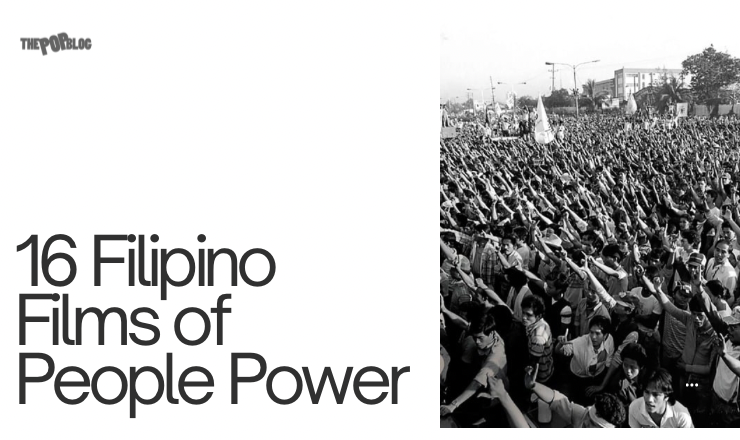
Dekada ‘70 was based on the acclaimed novel by Lualhati Bautista, written in 1983. As a book that exposed the brutality of the martial law of Marcos Senior’s regime, it became a powerful force that galvanized Filipinos go out on the streets of Edsa and oust the dictator in The People Power Revolution in 1986. The film is about a middle-class family as they navigate life under the Marcos dictatorship. It chronicles how their children become involved in different forms of activism and putting their family at risk.
Citizen Jake (2018)
Citizen Jake centers on a journalist and son of a Marcos crony who investigates the murder of a student. As he digs deeper, he confronts the dark legacy of his family’s past and the endemic corruption that still plagues the nation. It was Mike De Leon’s comeback film after nearly two decades of hiatus. It was also his last directorial film before his recent death in August of 2025.
Bayan Ko: Kapit sa Patalim (1984)
Directed by Lino Brocka, this film was smuggled out of the Philippines to be shown at the Cannes Film Festival because the Marcos regime banned it. It tells the story of a worker who, driven by poverty and injustice, is forced to turn to a life of crime. The title translates to “My Country: Holding on to a Knife,” a powerful metaphor for the desperation of the Filipino people. By the title itself, the film showcases how a rotten system can easily produce a rotten society and people.
Insiang (1976)
Another Lino Brocka classic, this film is a brutal portrayal of a young woman living in the slums of Tondo who is being abused. It strips away any romanticism of poverty and shows how extreme social conditions can lead to moral decay and violence. Its power comes from its raw depiction of how Insiang is betrayed by the people meant to protect her, particularly her complicit mother and her mother’s cruel lover. The film’s harrowing ending shows Insiang’s descent into vengeance, making it a powerful and timeless commentary on the plight of the vulnerable.
Heneral Luna (2015)
A historical epic that focuses on the life of General Antonio Luna. While fighting against American colonizers, Luna (John Arcilla) is betrayed by his fellow Filipino officials, highlighting how internal corruption and political infighting can sabotage even the most noble nationalist causes. Directed by Jerold Tarrog, I love the way that Heneral Luna was portrayed — as flawed as he can be — only shows the nuances of every person — and yet at the end of the day, Gen. Luna fought for the freedom of the Philippines.
Batch ’81 (1982)
A film by Mike de Leon, Batch ‘81, uses the brutal hazing rituals of a fraternity as an allegory for authoritarianism and the corrupting nature of power. It’s a dark probe into how young men are initiated into a violent and apathetic system. The film is narrated by its protagonist, Sid (played by Mark Gil), from his first to last initiation and submission to the fraternity’s fascist leaders, mistaking loyalty with compliance. The film is a parallel between the fraternity’s “discipline” and the unthinking obedience demanded by a dictatorship — how cycles of abuse and complicity are normalized and passed down through generations.
Liway (2018)
Based on a true story, Liway recounts the experience of a young boy who grew up in prison with his mother, a political dissident and anti-Marcos rebel. The film highlights the resilience and hope of activists who fought for freedom during a dark period in Philippine history. It’s a testament to the power of a mother’s love to create a world of hope and imagination even within the confines of a brutal prison — hopefully healing their wounds so they could live life in better terms.
Sakada (1976)
A film by Behn Cervantes, Sakada tells the story of sugarcane workers who organize a strike against an abusive landlord. The film’s depiction of the workers’ plight and the brutal reprisal they face directly mirrored real-life events, leading to its censorship and Cervantes’s arrest. The film’s critique of feudal oppression and class struggle was so threatening to the Marcos regime that it was banned, making it a landmark of defiance in Philippine cinema.
Goyo (2018)
Another masterpiece by Jerrold Tarog, Goyo follows the young general Gregorio “Goyo” del Pilar in the aftermath of General Antonio Luna’s assassination. Instead of a straightforward war epic, the movie examines what it means to be a hero. Like in Heneral Luna, the film portrays Goyo (Paulo Avelino) not as a flawless icon, but as a young, flawed, and insecure man blindly loyal to President Emilio Aguinaldo (Mon Confiado). The film’s central conflict isn’t just about the invading Americans, but also about the internal corruption and political divisions that doomed the revolution.
Pro Plata Mata (1982)
Directed by Peque Gallaga, this epic historical drama is set during World War II in the province of Negros. It’s the story of two wealthy haciendero families, the Ojedas and the Lorenzos, as they flee the Japanese invasion. The title, a traditional Filipino architectural superstition meaning “Gold, Silver, Death,” is a metaphor for the film’s three-part structure. It begins with the families’ luxurious “gold” existence, moves to a fragile “silver” refuge in the countryside, and ends in the horrifying “death” that transforms and corrupts them. The film showed how the brutalities of war strip away class distinctions and expose the moral decay and savagery that can reside within people, regardless of their social standing. It hauntingly showcased how even the privileged are not immune to the horrors of violence and how a corrupt world can turn its own victims into monsters.
Orapronobis (1989)
Lino Brocka’s raw and powerful film about the aftermath of the EDSA People Power Revolution. It shows that even after the dictator’s ouster, human rights abuses and political violence continue under the new administration. The film was so controversial that it was banned in the Philippines. And there might be a reason why it’s one of the least popular masterpieces—perhaps the new administration wanted to keep the narrative within the bounds of the Marcos regime and cover up the mistakes of others.
This listicle may be constantly revised, as we add more titles to it. If you think I missed your favorite movie on the list, send us an email at thepopblogph@gmail.com with the subject: Filipino Films of People Power: ___________ (name of film).
I’ll also feature an article about revolutionary films worldwide separately, so stay tuned for that.

NeP-C Ledesma is a millennial writer and entrepreneur full of curiosity about our abstract world. She devours Psychology, food, Philosophy, and prefer cats as her all-time company. Pop Culture is her kryptonite.