
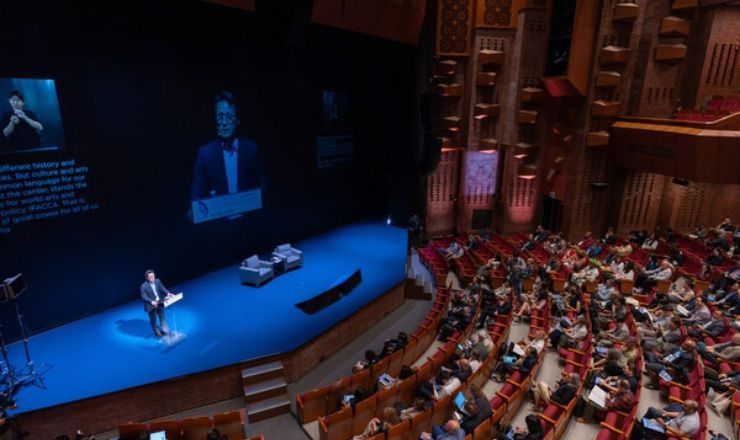
Against the backdrop of rapid technological transformation and climate uncertainty, Arts Council Korea (ARKO) and the International Federation of Arts Councils and Culture Agencies (IFACCA) successfully co-hosted the 10th World Summit on Arts and Culture from May 27–30, 2025. The event brought together 406 delegates from 94 countries, including 104 speakers from 62 nations, to confront pressing questions about the role of culture in an era defined by AI, environmental crises, and societal fragmentation.
A Summit for Our Times
Held in Seoul following the 2023 Stockholm edition, this year’s Summit centered on the theme “Charting the Future of Arts and Culture.” The gathering served as a critical platform for policymakers, artists, and thinkers to explore how cultural sectors can navigate—and shape—global transformations.
“AI is a risk to cultural heritage not because it’s intelligent but because it’s stupid,” declared Michael Running Wolf, AI ethicist and Lead Architect at First Languages AI Reality (FLAIR). Drawing from his Indigenous heritage, Running Wolf highlighted how standardized AI models threaten linguistic diversity and replicate colonial patterns of data exploitation. His work on Indigenous language revitalization offered a counterpoint, proving that technology can also empower marginalized voices when designed ethically.
Meanwhile, media artist Ayoung Kim of Ayoung Kim Studio reflected on the limits of speculative art: “I make questions, I make suggestions in speculative forms, but it doesn’t change the world.” Her statement sparked dialogue about the balance between artistic critique and tangible impact.
AI, Climate, and the Future of Cultural Rights
The Summit’s first plenary session, “The Future of Culture in Times of Exponential Shifts,” featured Dr. Alexandra Xanthaki, UN Special Rapporteur on Cultural Rights, who argued that culture must be framed as a human rights imperative. “Culture should not be confined to individual interests,” she asserted. “It must restore humanity and identity.”
Parallel sessions dug deeper:
- “Elastic Futurity in Korean Arts and Culture” questioned whether AI’s predictive capabilities might erode human imagination. Science fiction creators proposed narratives that resist binary optimism or dystopia, instead envisioning equitable futures.
- Climate-focused discussions showcased how the arts can foster community resilience, with case studies on participatory systems addressing polarization and regional disparities.
Beyond Talk: Experiential Culture and Policy Innovation
Breaking from traditional conference formats, ARKO curated an immersive cultural program under the symbolic theme of “wind.” Delegates experienced:
- Traditional Korean hospitality via bojagi-wrapped lunchboxes
- A museum tour bridging classical and contemporary art
- A K-pop-inspired Gala Opening celebrating Dano Day
- Explorations of Daehak-ro’s vibrant street and culinary culture
“The Summit’s design left a lasting wind of inspiration,” remarked one attendee.
Interactive sessions like the World Café fostered egalitarian dialogue, with participants co-creating 2050 roadmaps for cultural policy. Rafael Ivorra Zaragoza, IFACCA board member and Spanish Ministry of Culture official, praised the format: “Such dialogue helps us understand policy cases from different countries.”
ARKO’s Leadership in Global Cultural Policy
The Summit spotlighted ARKO’s innovative programs, including:
- Munhwanuri Card (Cultural Voucher) – Expanding arts access
- Youth Culture & Art Pass – Engaging younger generations
- APE CAMP – Supporting sustainable cultural ecosystems
International policymakers lauded ARKO’s execution capacity and collaborative approach, signaling Korea’s rising role as a global culture hub.
From Dialogue to Action
The Summit closed with a resounding call for global solidarity. Kristin Danielsen, IFACCA Chair and CEO of Arts and Culture Norway, linked the discussions to UNESCO’s upcoming MONDIACULT 2025 conference, framing Seoul as a “platform for shared thinking and connection.”
ARKO Chair Byoung Gug Choung urged delegates to move “from query to action,” emphasizing culture’s power to address inequality. “Act and connect from wherever we are,” he declared—a mandate echoing beyond the Summit’s walls.
The Road Ahead
As the curtain fell on the 10th World Summit, attendees departed with new alliances, policy models, and a reinvigorated mission: to ensure culture remains a force for resilience and equity in turbulent times. With MONDIACULT 2025 on the horizon, the Seoul Summit has set a bold precedent for global cultural cooperation.
Photo credits: ARKO/IFACCA

The Pop Blog general news and updates, mostly from press releases and conferences.