
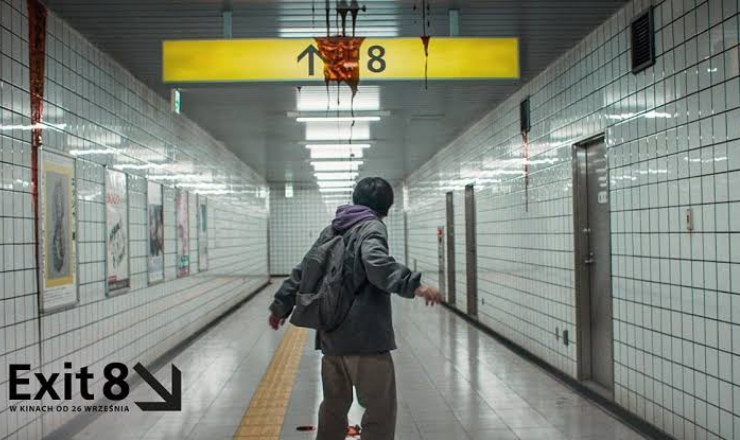
We have all experienced the fleeting, disorienting moment in a sterile, public space: a sudden uncertainty about whether we’ve passed this same vending machine or this specific pillar before. It’s a glitch in our mental map, quickly dismissed. But what if the glitch wasn’t in you, but in the world itself? What if that moment of uncertainty stretched into an eternity? This is the foundational nightmare of Exit 8, a masterful short film directed by Genki Kawamura, adapted from KOTAKE CREATE’s simulation game “8ban Deguchi.” It is a film that transcends its concise runtime to explore profounf themes of perception, sanity, and the terrifying logic of an illogical world.
The setup is instantly relatable. A man, played with breathtaking vulnerability by Kazunari Ninomiya, is trying to find his way out of an underground subway passage. The environment is a masterpiece of mundane dread: impeccably clean white tiles, the relentless hum of fluorescent lights, a path that bends with bureaucratic predictability. His goal is simple: find Exit 8. The problem, however, is immediately and horrifyingly complex. The passageway loops endlessly. He sees the same potted plant, the same wall markings, the same empty stretch of corridor, over and over again. He is a rat in a maze where the exit sign is visible, but the path to it has been deleted.
The film’s genius is crystallized in the official instruction presented on an information sign, a piece of text that becomes the movie’s twisted bible: “Do not overlook any anomalies. If you find an anomaly, turn back immediately. If you do not find any anomalies, do not turn back. Go out from Exit 8.”
This is not just a rule; it is the entire narrative and philosophical engine of the film. It presents a paradox that would strain any rational mind. It forces the protagonist—and by extension, the viewer—into a state of hyper-vigilant paranoia. What constitutes an “anomaly”? Is it the plant? A scuff on the tile? A flicker of a light? The instruction demands absolute certainty in a situation designed to breed doubt. The command to “turn back immediately” upon finding an anomaly introduces a punishing risk-reward structure: progress is punished, while the absence of perceived danger is the only path forward. This transforms Ninomiya’s journey from a simple search for an exit into a terrifying test of observation and will. His performance is a masterclass in silent escalation. We watch the competent, suited everyman devolve from confusion to determined problem-solving, to frantic experimentation, and finally to the hollow-eyed realization that his own senses may be betraying him.
Director Genki Kawamura, best known as the producer of blockbuster anime like Your Name., demonstrates a masterful understanding of cinematic language here. His direction is clinical and precise, mirroring the sterile environment of the game. He uses steady, wide shots to emphasize the crushing repetition of the architecture and the profound isolation of the single human figure within it. The sound design is ruthlessly minimalist—only the echoes of footsteps and the hum of lights—forcing us to lean into the silence and become active participants in the hunt for anomalies. We are not merely watching The Wandering Man; we are with him, our eyes scanning every corner of the frame, questioning every detail. This is the ultimate success of the adaptation from KOTAKE CREATE’s simulation game: it translates the core, interactive mechanic of observation into a deeply immersive and passive cinematic experience.
The film operates on multiple levels. On the surface, it is a perfect horror-thriller. The introduction of a second figure—a motionless man standing facing the wall—is a heart-stopping moment that perfectly exploits the rules. Is this the ultimate anomaly? Is it a trap, a trick, or another lost soul? The film offers no easy answers, masterfully sustaining its ambiguity to the final frame.
On a deeper level, Exit 8 is a potent allegory for modern life. The Wandering Man is a quintessential salaryman, trapped in the endless, sterile loop of routine. The instruction manual is the baffling and often contradictory set of societal and corporate rules we are told to follow for success. The promise of “Exit 8” is the illusion of progress and fulfillment in a system that feels designed to keep us moving without ever letting us truly arrive. The loop is the daily grind, the endless scroll through social media, the cyclical nature of anxiety itself—a path that feels familiar yet leads nowhere.
The film also delves into existential philosophy, questioning the very nature of reality and perception. The anomaly is the crack in the simulated world, the hint that the universe is not as solid as it seems. The instruction to ignore the anomaly or be punished for seeing it is a chilling metaphor for the pressure to conform, to accept the consensus reality even when our instincts scream that something is wrong. Ninomiya’s character is not just lost in a subway; he is lost in a crisis of epistemology. How can he trust what he sees? How can he know what he knows?
The ending, true to the spirit of the best weird fiction, provides no easy escape. The possibility of Exit 8 is presented, but it is framed with such haunting ambiguity that it offers no catharsis. Has he broken the loop by perfectly following the rules? Or has the loop simply evolved, presenting him with a new, more sophisticated illusion of freedom? The true horror of Exit 8 is that the labyrinth is not just made of tiles and lights, but of the mind itself. Even if the body escapes, the psychological scar—the knowledge of the loop, the ingrained paranoia, the shattered trust in a coherent world—remains forever.
In conclusion, Genki Kawamura’s Exit 8 is a monumental achievement in short-form cinema. It is a tightly wound, exquisitely crafted nightmare that uses its simple premise and game-based rules to explore profound and unsettling questions. Anchored by a phenomenal, wordless performance from Kazunari Ninomiya, it is more than a horror film; it is a psychological puzzle, a societal critique, and a philosophical treatise on the fragility of reality. It is a film that, long after the screen goes dark, forces you to become your own Wandering Man, questioning every corridor, every sign, and every seemingly innocuous detail in your own world.

RJ Tantoco is a writer and researcher with a passion for all things strange, geeky, and genre-bending. Whether it’s horror slashers, offbeat indie gems, or the latest multiverse mind-bender, RJ dives deep. His writing blends fandom with sharp analysis, offering fresh takes on cult favorites and cinematic oddities alike. When he’s not watching movies, he’s probably studying for his masters or deep on an RPG quest.