
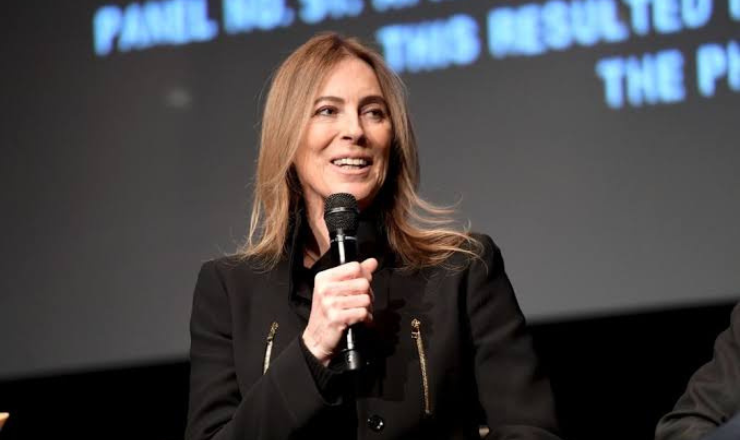
Acclaimed director Kathryn Bigelow unveiled her latest cinematic endeavor, A House of Dynamite, a gripping political thriller that premiered on September 2, 2025, at the Venice Film Festival, thrusting the specter of nuclear catastrophe into the spotlight. After an eight-year hiatus since her 2017 film Detroit, Bigelow returns with a visceral, real-time drama that captures the frenetic chaos of White House officials grappling with an unidentified missile hurtling toward the United States. Starring Idris Elba as the president and Rebecca Ferguson as a senior official, the film is a stark exploration of the existential dread surrounding nuclear arsenals, a subject Bigelow believes demands urgent global attention. Her hope is that this taut, 112-minute narrative, which unfolds over a mere 18 minutes of crisis, will ignite a conversation about the perilous reality of living in a world armed with enough weapons to end civilization.
Bigelow, whose career has long been defined by her unflinching engagement with the fault lines of American power, spoke passionately at the Venice press conference about the film’s purpose. “Hopefully the film is an invitation to decide what to do about all these weapons,” she told Variety. “My answer would be to initiate a reduction in the nuclear stockpile. How is annihilating the world a good defensive measure?” Growing up in an era when schoolchildren were taught to hide under desks as a futile defense against atomic bombs, Bigelow, now 73, is acutely aware of the escalating dangers. “Today, the danger has only escalated. Multiple nations possess enough nuclear weapons to end civilization within minutes,” she said, decrying the “collective numbness” that normalizes this unthinkable threat. Her words carry the weight of a filmmaker who has consistently tackled geopolitical anxieties, from the psychological intensity of The Hurt Locker, which earned her the first best director Oscar for a woman, to the decade-long hunt for Osama bin Laden in Zero Dark Thirty. A House of Dynamite marks a return to this high-stakes terrain, blending her signature kinetic style with a sobering reflection on humanity’s precarious existence.
The film, written by Noah Oppenheim, a former NBC News president, unfolds in a pressure-cooker scenario: a single, unattributed missile is detected, sparking a desperate race to identify the aggressor and decide on a response. Shot across locations in New Jersey, Washington, D.C., and Pennsylvania between September and December 2024, the narrative tracks the 18-minute trajectory from launch in the Pacific to potential impact in Chicago, immersing viewers in the situation room alongside a stellar ensemble cast. Idris Elba, portraying a president faced with an unthinkable decision, described the filming process as akin to “being in a documentary,” its ultra-immersive approach designed to mirror the real-time tension of such a crisis. “It was quite intense and realistic of what we understood to be the true situation of what could happen,” he said, adding with relief, “I am grateful that I’ve never been put in that situation and had to decide what to. I don’t have the courage to be involved in politics.” Rebecca Ferguson, playing a senior official tasked with maintaining governmental stability amid the chaos, anchors the film’s emotional core, joined by a robust supporting cast including Jared Harris as the defense secretary, Tracy Letts, Anthony Ramos, Gabriel Basso, Moses Ingram, Jonah Hauer-King, Greta Lee, and Jason Clarke, who reunites with Bigelow after Zero Dark Thirty.
Oppenheim’s screenplay, developed over two years, aims to reflect “the reality of our world since the dawn of the nuclear age,” emphasizing the universal stakes over specific geopolitical tensions. “Now there are nine countries on earth that have nuclear arsenals that could end human civilization, several times over,” he noted, highlighting the miraculous fact that a catastrophe has not yet occurred. The script underscores the terrifying reality that, in countries like the United States, a single individual—the president—holds sole authority to authorize nuclear weapon use, with many warheads poised on hair-trigger systems. “It’s miraculous, frankly, that something horrific hasn’t happened already,” Oppenheim said, a sentiment echoed by Jared Harris, who admitted the role was harrowing: “I am grateful that I will never be put in that situation.” Bigelow and Oppenheim construct a “frighteningly plausible” scenario, as described by the New York Film Festival, where practical, personal, bureaucratic, and existential dilemmas collide under an unforgiving timeline, drawing viewers into the heart of a decision-making process with world-historic consequences.
Bigelow’s return to Venice, where The Hurt Locker received a 10-minute standing ovation in 2008, was met with rapturous applause, prompting her to quip, “I wish I could start every day like this. I should make more movies.” Her career trajectory—from cult thrillers like Point Break and Blue Steel to politically charged dramas like K-19: The Widowmaker—has always inverted expectations, blending genre innovation with incisive social commentary. Born in San Carlos, California, in 1951, Bigelow transitioned from painting and conceptual art, studying under Susan Sontag at Columbia, to filmmaking, which she saw as a medium that “crosses culture and class.” Her ability to craft visceral, character-driven narratives within large-scale geopolitical frameworks has cemented her as one of cinema’s most decorated directors. A House of Dynamite, produced by Netflix alongside First Light Pictures, Kingsgate Films, and Prologue Entertainment, continues this legacy, with a creative team including cinematographer Barry Ackroyd, production designer Jeremy Hindle, costume designer Sarah Edwards, editor Kirk Baxter, and composer Volker Bertelmann, whose score blends real and electronic instruments to evoke a haunting atmosphere, complemented by Paul N.J. Ottosson’s sound design.
The film’s premiere at Venice, where it competes for the Golden Lion alongside Netflix’s Frankenstein by Guillermo del Toro and Jay Kelly by Noah Baumbach, positions it as a strong awards contender, with a limited theatrical release planned for October 3 in the UK and October 10 globally, followed by a Netflix streaming debut on October 24. Venice has proven a fertile ground for Oscar hopefuls, and Netflix, still chasing its first best picture win, is banking on Bigelow’s track record. The Alexander Payne-led jury will announce awards on September 6, but beyond accolades, Bigelow’s mission is clear: to provoke a global dialogue on nuclear non-proliferation. “This is a global issue, where we are with nuclear weapons,” she said, her voice tinged with urgency. “Of course, hope against hope is that we reduce the nuclear stockpile one day. But in the meantime, we are really living in a house of dynamite.”
The film’s prismatic structure, as noted by the New York Film Festival, entangles intimate human dramas with the broader specter of annihilation, offering a thought-provoking exploration of a nightmare scenario that feels all too real. Bigelow’s own childhood memories of Cold War drills underscore the personal resonance of the project, while her meticulous research into the U.S. nuclear stockpile—who guards it, what happens in a crisis, and who makes the call—grounds the film in chilling authenticity. The ensemble cast, described as conjuring “vivid characters with muscular efficiency,” brings emotional depth to the taut narrative, ensuring that the human stakes remain as palpable as the geopolitical ones. For Bigelow, the film is not just a thriller but a call to action, urging audiences to confront the paradox of a world that normalizes the tools of its own destruction. As A House of Dynamite prepares to make its mark on the festival circuit and beyond, it stands as a testament to Bigelow’s enduring ability to hold a mirror to society’s most pressing fears, demanding that we face the unthinkable before it becomes reality.

The Pop Blog general news and updates, mostly from press releases and conferences.